
The main interaction mechanism between a charged particle and the crossed material is the collision.
Mainly the collisions occur with the atomic electrons of the crossed medium, rarely with the nuclei since the masses of the nuclei of most materials (especially those used for constructing detectors) are large compared to the incident particles. In all cases the collisions cause the transfer of an amount of energy from the incident particle to the target and a deflection of the same: the struck atom goes in an excited state and, if the energy is large enough, the hit electron can be detached from its atom creating an ion (primary ionization).
If this electron reaches an energy enough large, can cause ionization in turn (secondary ionization). In this case the electron is referred as δ-ray. We do not have to think to a collision between two bodies which come simply in contact with their mass, rather to a collision that is the effect of the electromagnetic interaction between the charged particles.
In
this scenario is clear that a particle can
also interact with electron far from itself
(the so called distant collision) and the
definition of the collision process is a
difficult problem to solve.
The quantity that characterizes the collision process is the so called cross section. Considering a beam of particles with an uniform distribution and F particles per unit of time impinging on a target particle. If we look at the average number of particle Ns scattered into the solid angle dΩ in the unit of time we can define the differential cross section as:
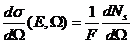
The
total cross section will be the integral
over the entire solid angle:
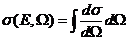
This
quantity has the dimension of an area and
can be considered as the section normal to
the beam direction outside of that the
particle is not deflected. However, despite
this definition, we have to think the cross
section just as a measure of the
interaction’s probability: the larger is
this quantity the greater is the probability
to have an interaction. According to this
last definition the cross section can be
defined not only for collisions but also for
other kind of interactions.
References
- W. R. Leo Techniques for Nuclear and Particle Physics Experiments
Anything missing? Write it here